The Empress of Ireland was a part of an ageless era of luxury transatlantic liners. When ships were the primary mode of transportation across the Atlantic, they were built both for function and beauty. They were adorned with brass portholes, teak wood decking, ceramic tiles and grand ornate art decorating the interior as if a floating palace—if one thing is for sure, they don’t make them like this anymore. Ships like these were almost destined for disaster and the Empress found her fate at the bottom of the St. Lawrence River on May 29, 1914. Just two years after the epic Titanic disaster, it was declared that such a tragedy would never be allowed to occur again. Just two years after, fear was still fresh in the minds of those who ventured to brave the Atlantic by way of ship. Just two years after, it happened again.
Despite a vow to never repeat such a tragic disaster, many ships still existed
that were built in a manner similar to that of the Titanic.
For this, it would result in the cause of the greatest disaster in
Canadian maritime history. The
Empress was built with watertight compartments to isolate damage and to control
listing following flooding; however, exactly like the Titanic, these watertight
bulkheads did not rise high enough nor were they sealed to prevent water from
spilling over in a watery domino effect. When
the Norwegian coiler Storstad rammed the starboard side of the Empress, the bow
tore a 10-meter wide gash in the heart of her hull. The Storstad was outfitted with an ice-cutter bow (double
hull) and as a result, she sliced into the comparatively thin-skinned Empress
delivering a fatal blow.
While the Storstad was found to be at fault by a court of inquiry, it was clear
that both vessels were to blame. On
a collision course in thick fog, each vessel turned to port instead of
starboard. Had each vessel turned to starboard, the ships would have
safely left each other passing port-to-port sides.
However each made a critical mistake and the Storstad slammed into the
Empress’s starboard side. This
occurred at 1:55 AM. Almost
immediately the Empress began to list to starboard as the Storstad backed out of
the hole and water poured in at a rate of over 60,000 gallons per minute.
Five minutes after the collision, the steam engines were flooded and the
ship was in total darkness. Panic
and chaos ensued, as there was no time to ready lifeboats or organize
passengers. The ship listed to
starboard at 70 degrees pinning many to the walls, blocking exits.
Others sleeping in cabins or trapped in the third class areas never had a
chance. Children were victims among
the harshest of casualties—out of 138 there were only 3 survivors.
In fourteen
minutes the Empress had completely foundered and at 2:09 AM she forever
disappeared from sight into the cold, black water where she rests today.
In total, there were 1012 lost, 840 passengers among them.
There were more passengers lost on the Empress than the Titanic by
comparison. The Empress of Ireland,
the Titanic of the St. Lawrence, can be found approximately 3 miles off
Point-au-Pere in Rimouski, Quebec. Swirling
strong currents, dark, icy cold water and unpredictable weather guard her.
The diving is difficult, and the Empress is unforgiving but those who
venture to the site will find a mystery and intrigue that is inexplicable,
compelling and haunting. We spent 6
days on the wreck and did a total of eleven dives. This is our story.
June
23, 2002/Dives 1 and 2:
We met at the marina at about 8 am
to depart for the Empress of Ireland. The
marina is the only one in Rimouski and is presently most notable for the large
Canadian destroyer docked nearby. The
Nipigon, a decommissioned navy ship, will be sunk next August thereby creating a
new dive site. The ship has been
stripped of most of its deck gear and as a result has risen three feet above its
waterline. The wreck, like the
Yukon of California, will be altered to create exits and easy points of
navigation for divers. However, as
the locals say, they are going to sink this one upright.
We met Jean-Pierre Bouillon and his family the day prior so we had
already checked out the boat and marina area.
At 8 AM we arrived at the marina ready to go, the conditions looked
great!
The boat is a small 27’ Cristcraft that is set up
for diving. It has a swim platform
and ladder. It is best suited for 4
divers using doubles and stages, although 6 could cram on. We loaded up quickly and got underway. The seas were flat calm and there was only the slightest of
breezes. The boat cruised at a fast
speed and in less than thirty minutes we were coming up on the buoy marking the
wreck of the Empress. A large white
moored buoy marks the grave of nearly 1100 people. Its nothing of a memorial, it only indicates that the wreck
is protected both in French and English. The
lines were readied by crewmember Simon, who was acting as both crew and
translator for us since Jean-Pierre, the captain, spoke little English.
The lines were tied off such that they ran from the stern of the boat to
the mooring. The granny ran from
the stern to the mooring with the boat settled into a v-shape in between. The swim along the granny was long, about 50 feet pulling
along the surface.
We prepared to dive right away.
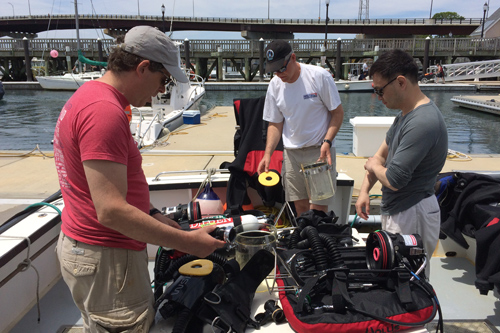
Dave and I began to get ready first with the help of Lee and Paul.
The weather was warm and the sun was bright.
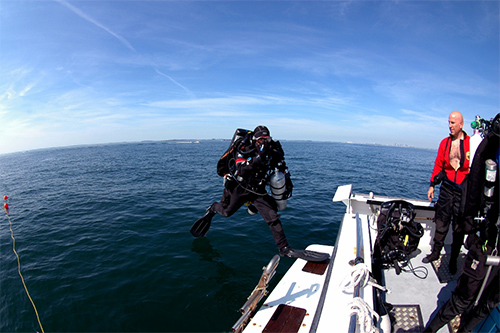
The freshness of the day was still upon us as we rolled over the side.
It was necessary to hang onto a line when going over the boat to avoid
being carried away by the fierce current. Someone
held the other end of the line, holding it taught keeping you near the boat
until you gave the ok. The long
swim began pulling hand over hand along the granny.
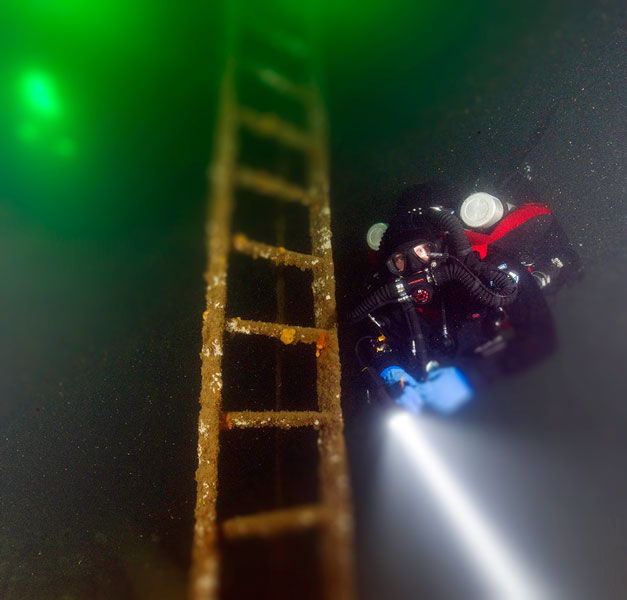
The water was a bright green but you knew immediately that it would be
dark all too soon. We reached the
mooring downline and took a quick rest to catch our breath.
The current was running hard. We
began our descent and almost immediately we were surrounded by darkness.
From about 40 feet on it was a night dive.
The visibility diminished to about 10 feet.
We dropped down the line and we reached the wreck at about 80 feet and
the visibility was now about 5-7 feet. The
first thing I noticed was the rail and two portholes.
The chain was looped through them. The
rail was fully intact and the hull was covered in anemones.
The current was furious on the wreck, and the darkness enveloped like a
cloak. Hanging onto the wreck with
one hand and pointing the video camera with the other, I tried to steal a
glimpse of this forgotten relic beneath the waves.
But this wreck does not give up its secrets easily.
The darkness, cold and sweeping currents are the ghosts which guard this
wreck. We began to swim forward
towards the first class area and bow- or rather, pull hand over hand.
The currents were so strong that you had to physically hurl your body
over wreckage to avoid being pinned against it.
It was becoming unmanageable with the camera.
I could not clear a turn to drop down part of the wreck with it and hang
on at the same time. I felt like I
was jumping over hurdles at times trying to swing my body.
The current was running strangely we were later told.
Normally it breaks over the hull but for some reason that day it was
running against the deck, up and over the hull.
Basically it was like an upwelling of current, which then swept off the
hull. Anyway, still trying to video and hang on, Dave was slowly
disappearing; the faint glow of his light grew dimmer and dimmer.
I was in pitch-blackness aside from the small lights on my helmet (I
borrowed this camera and it does not have lights).
For a few moments I waited trying to break free of the paralyzing current
but was completely alone in the dark. I
couldn’t see anything at all and I was getting sick of this camera already.
As it turns out this would be the last dive I brought it on.
Dave returned finally and I indicated that it was time to lose the
camera. We swam back to the mooring
and clipped off the camera. With two hands, more light and less equipment, I was free to
swim and move more easily.
We dropped straight down the deck as the wreck is
nearly on its starboard side. Wooden
planks are still visible and small stanchions, which used to hold the rails, are
some of the crumbling remains of this once luxurious liner.
We rose up over the top of the wreck again and braved the current back to
the mooring. We began our ascent at
about 25 minutes bottom time. A
short deco stop on oxygen and we surfaced.
Whisked away by the current, were back to the boat in no time at all.
Upon arriving on the boat, Simon pointed out that my strobe was full of
water, flooded out completely. That
was the end of the strobes on this trip and an early sign that I was going to
lose some gear.
After a two-hour surface interval we geared up for
another dive. This time I left the
camera behind. We rolled over
the side and found the surface current was very strong.
The water was swirling past the boat.
We dropped down the line and soon were enveloped the cloak of darkness on
the wreck. We penetrated through
the blast hole and swam up back towards the mooring where a swing plate was
lingering. While the wreck is
protected from recovering artifacts, it never hurts to look just to see what
you’re missing out on. Inside the
wreck, darkness became darker as I shielded over my light to see if any light
was visible outside the wreck. It
was pretty much black, complete sensory deprivation and we weren’t even that
far inside. We came out of the
wreck and headed aft again. Dropping
down the deck again we encountered strong currents.
Letting go of the wreck to push off, the current quickly reached out,
pulling you away. The water was
colder on this dive, and when our hands started get numb, we headed up.
The currents swept us back to the boat in the blink of an eye.
We climbed aboard and headed in looking forward to more dives.
Just as we were leaving, the wind shifted and began to blow heavily in
one last attempt to dispel us. The
outline of the wreck appeared as the currents swirled around it in an eerie
silhouette. It was spooky.
Heavily wind and seas cancelled all diving for today.
Instead we visited the Musee de la mer.
The wind was roaring and there was no way we were diving.
There is not a whole lot to do in Rimouski aside from diving or talking
about the Empress so we figured the Museum would be the best place.
It is an impressive place, which has evolved over the years.
The Empress is the primary focus although there is some general
information about other Empress steamers and the evolution of navigation in the
St. Lawrence. One of the coolest
rooms is one that is set up as if you are inside the wreck.
The room is canted to the angle of the wreck and there are some artifacts
and portholes in there. You can really get a sense of how disorienting it must have
been to try and escape the ship as it listed over.
Also very interesting was the diving exhibit where many of the Empress
pioneers are profiled. There are
interviews playing on tape where various accounts of great escapes and near
misses. Filmmaker Terry German told
one such tale. He had entered an
area of the wreck intending to shoot some video.
When he placed the camera down to make some adjustments, he started an
avalanche of debris, unearthing about four-dozen skeletal remains, many of which
were children. The bones completely
blocked his only exit and reduced the visibility to zero.
Somehow, he was able to collect himself and escape the area, however, he
did not record a single image. Our
captain, Jean-Pierre had a serious accident diving the Empress over ten years
ago, which left him partially paralyzed and unable to ever dive again.
This wreck has not been kind.
June
25/Dives 3 and 4
We met early for breakfast hoping for a great day of diving, as today was to be Lee and Paul’s last day out with us. We prepared for an 8 am departure and we were ready. After a day of sitting around waiting for the seas to subside, we had cabin fever. Although we spent a few hours at the Musee de la Mer where there is an extensive collection of Empress artifacts and history, we wanted to go to the real museum. Heading out to the Empress we were pleased to see that the conditions were improved. A choppy 2-foot sea lingered but it was subsiding as the day went on. We arrived on the Empress to find a surprise. The midships mooring was gone. It was interesting because there was one spot we all want to go, something we all wanted to see. We were determined to get back there. To arrive on the site and out of the three moorings on the wreck, that one was gone. The moorings were brand new; they had only been there a few days. Not meant to be I suppose. Later in the trip when Dave and I returned to the midship area, we did go to see what we had wanted but the opportunity had passed. The Empress only permits a glimpse, nothing more. We decided to dive the stern section since Dany’s boat was anchored up on the bow.
Dave and I entered the water after Lee and Paul
today. We rolled over and
immediately were seized by the gripping current.
The surface swim was much shorter than on the other mooring as there was
more scope on the line allowing us to get closer to the ball.
We reached the downline and began to descend.
The current raged but we continued to descend. There
was a lot of scope on the line and as we got deeper and the visibility dimished
to a few feet, it became rather disorienting.
I had separated from Dave on the line after we passed Lee and Paul.
I reached the wreck and began to look for Dave.
When I shined my lights around I saw that Dave was nearby but hard to
see. I tried to get my bearings but
didn’t have time really as I was more focused on where Dave had gone.
The current was ripping and since it was a new section of the wreck, I
was unfamiliar with the surroundings. Dave
returned and we immediately dropped over the rail and headed forward.
We have not been running lines at all so it’s extremely important to
know your surroundings. I was not well oriented and fighting a strong current, I was
not comfortable with the way the dive was progressing. I did not feel that I had gotten my bearings and we had too
quickly left the area of the mooring. I
like to know where I am all the time, to understand the wreck and “see”
where I am. Even when you dive with
someone, you need to know where you are, especially if you get separated and
need to return to the surface alone. I
was disoriented with respect to where we were and in the poor visibility was
having a hard time seeing Dave. I
decided to turn us around, as I was less and less comfortable as we got further
away. I got Dave’s attention and
signaled I wanted to turn around. We
were about 20-30 feet from the mooring when popped up on top of the rail and
swam back towards the anchor line. Up
on top of the rail the current hit like a train and I was getting tired swimming
against it. This dive just wasn’t
going right and I did not feel good about it.
I gave Dave the thumbs-up and we headed up-- and up is always good. On the surface we talked about what had occurred.
The first problem was that we became separated and out of communication
with each other without a plan. Dave
reached the wreck first and had already familiarized himself with the location
(he has also dove this wreck before and has a better sense of it).
I had not gotten my bearings at the mooring and had not been able to
communicate to Dave that I wanted to get oriented before departing the mooring
area. The poor visibility and
currents added to the stress and task loading of trying to communicate and
navigate without lines. We agreed
that better communication and planning was necessary.
We did not want to run lines but we just needed to slow down until we
both were comfortable navigating the wreck.
After a 1 ½ hour surface interval
we geared up to enter the water again. We
agreed on a dive plan this time and had decided to drop into the debris field
Lee and Paul located at 120 ft. We
entered the water and we battled the current to the mooring line. We took a quick break just below the surface to relax from
the strenuous swim. We began our
descent and reached the wreck comfortably.
I was now familiar with the area from my previous dive. If there is one good thing about being stressed out during a
dive, its that it kicks you in the a**. You
always learn more from the difficult dives where you find yourself in a
“situation” than the uneventful easy ones. We already knew what the plan was so we began to drop down
the deck. It was very dark and
there was an upwelling current running along with the sweeping current pulling
you forward. We reached the debris
field, which was most notable for the piles of “puzzle pieces” that at one
time made up the floor in the bar area. Also
nearby was a deck chair. We pawed
around for a while and scouted out interesting areas that we wanted to return
to. We were careful not to become
disoriented. With currents like
these you tend to move laterally very easily and in 5-7 feet of visibility you
can be far from your point of origin in no time.
As a result, we spontaneously resorted to using each other as markers,
plotting our positions with our bodies, moving like chess pieces.
This way, we always had a “known” point, a virtual path to return to
our origin. We could cover more
area this way and work together to get where we wanted to go.
When you have a problem during a dive, you always try to learn something
about what went wrong or why you felt a certain way so you don’t do it again
and you can manage more effectively if you encounter such a problem again. On this dive, we corrected all the mistakes made on the
previous dive. Our hands began to
get very cold so we headed up the face of the deck.
We stopped off briefly at one of the exterior corridors running along the
deck. We popped up on the rail and
braved the current to clip things back on and return to the surface.
On the way to the surface I noticed Dave was distracted by something.
He was lagging behind on the ascent so I dropped back down.
I saw his arm was against his body and I thought he was stuck or
something. I took a closer look and
realized his waist buckle and crotch strap had come undone and his tanks were
pulling off him. I came over and
while he held onto the line (current was ripping of course) I threaded the waist
strap through and closed the buckle. The
funny thing was that Dave had just installed a sleeve to slide over the buckle
precisely to prevent it from popping open. Just another of the strange and unusual occurrences we have
experienced during dives on this wreck. Nevertheless,
we headed back to the marina most pleased with the day.
June
26- Dives 5 and 6
We bode farewell to Lee and Paul and headed back out
to the Empress for a private charter. Dave
and I decided to dive the bow section today thereby giving us 2 dives on each
section of the wreck so far. We
arrived on site and the conditions were decent.
Maybe a one-foot chop but the current was racing.
It was creating waves over the buoys and making a large wake off the
boat. We rafted up with Dany and a
few of his friends, including his dog, Nitrogen.
We chitchatted for a while, as the current was too strong to dive.
After about an hour the current slowed enough to make a dive.
Dave and I geared up and rolled in.
Just the two of us had the bow all to ourselves.
We reached the wreck in strong currents.
Right away we knew to drop over the rail to find some relief.
We began dropping down the deck in rather poor vis, maybe 7 feet.
We were dropping down sideways to stay oriented to parallel to the
decking. Dropping down the deck, my
legs whacked something and I looked to see that two giant bits were there.
You almost couldn’t see it unless you hit it.
I thought it was cool to see that—I went back later and saw them on a
picture of the ship. This was
typical deck gear for the bow. We
began to make our way aft towards the first class promenade area. We encountered collapsed bulkheads and debris where
superstructure once stood. We
dropped down some more and checked out a shed at almost the mid-ships area.
It was extremely disorienting to look at; it is one of the more
“intact” objects we have seen. Imagine the wreck angled at 70 degrees, almost on its side.
Now imagine something coming up at a 90-degree angle off something at 70
degrees. NOW, imagine it angled
over about 20 degrees toward the bow. Are
you completely confused yet? Well,
this just gives you an idea of how screwy it can be to look at something
underwater that is not upright. Your
eyes and middle ear are constantly trying to right yourself.
When you see something like this, it messes with you.
In the poor vis, you could no longer see the wood planks running the
length of the deck, the only thing that can really give you a sense of
orientation. Anyway, we popped
around a bulkhead and worked our way forward.
We came up over the rail and braved the current to drop down the hull.
We wanted to see the letters of the name “Empress of Ireland”.
We started dropping down and struggled not to be swept away by the
current. There was nothing to hold
on to, as it was very smooth. In my
grasping however, I pawed over a fully intact, premium-find complete porthole
with glass and everything. I tapped
the glass a few times just to hear it tap.
Then, I moved on knowing it was off-limits since the wreck is protected.
We did not get to the letters, it seemed to be deeper down the hull than
it was wise to venture in the current. We
popped up on the rail and headed up.
We did a nice comfortable surface
interval and entered the water for our sixth dive, second for the day.
The current on the surface had let up a little since the tide was
changing. But just when you think
the Empress is giving you a break, she laughs right at you.
We started dropping down the line and the current was so strong I thought
my tanks were being ripped off my back. For
a second, I thought about Chip Kelly’s wingnut incident on the Doria and
wished I had checked mine. But, not
to fear the tanks were on. The
current was just so strong it wanted to turtle you on the line.
We reached the wreck and the visibility was just about zero.
The bottom current was real tough and it had totally trashed the vis.
We dropped down the deck again to escape the current.
While swimming along we saw a bunch of flowers tacked to the wreck with a
diver’s weight in a ghostly memorial. The
flowers had been there only a day but were already covered with a thin layer of
gray silt. Right away I knew what
it was and gave pause to be especially careful not to disturb it.
While the Empress is a fascinating dive with an intriguing story, she is
forever linked with tragedy. Not
just the tragedy of her demise and the 1012 souls she took with her, but those
that continue even today. In 1996
there was a double fatality on the wreck. Lise
Parent, an experienced local diver, dove down to the wreck to tie in a line.
She became tangled in the line, ran out of air and drowned.
Another diver, Xavier Robbain, entered the water to recover her body.
During the recovery, while escorting her body to the surface he lost
control of his buoyancy as his grip slipped on her body.
He raced to the surface and died of an air embolism.
Just the other day, Lise’s husband visited the wreck to place the
flowers there. Having seen the
memorial to them at the museum the other day, it was especially sad to see the
flowers there. We continued the
dive with a grim reminder of what we were diving: a cemetery.
We continued aft again, dropping down to hold that were ripped open from
the collapse of the deckhouses. Peering
inside, a veritable abyss awaited those who braved the darkness to venture
beyond. We revisited the deckhouse
I described in the previous dive. Despite
the near zero visibility, we were familiar with the surroundings and oriented to
obtuse metal twisted around us. Our
teeth were chattering away and hands had long since gone numb so we returned to
the surface and waited for our next chance to visit the Empress.
June
28/ Dive 7
Today we had some new faces aboard the boat.
Jack, Donna and Greg were on for the next three days.
The morning broke with heavy fog and rain.
However, there was no wind and the seas were flat calm, like glass. We fired up the radar and headed out. We were instantly swallowed up into the fog.
After a timeless travel in a white haze, we arrived at the Empress.
Some of the people were a little concerned about getting blown off the
wreck in the current in fog. They
asked what they should do if they got blown off. The collective consensus was,
“don’t get blown off”. Simple
enough, end of discussion. Anyway,
we snuck up on her it seemed. The
seas were flat calm; there was not even a drop of current or wind.
Something was up.
Upon arriving at the Empress we began to help the others get ready.
The eerie quiet was something we had not yet experienced. I rolled off the boat first.
Upon entering the dark water I felt something funny on my head.
I had not hit the water strangely and in fact it was a smooth entry.
I reached up to touch my head and to tap my head to give the “ok” and
discovered my helmet was gone. I
quickly turned behind me and peered down. In
the green abyss I saw my helmet as it slowly disappeared into the deep.
There was no going after it; it was gone.
My helmet has guided me through the darkness on many, many dives and
today on the Empress we parted company. I
had checked the clip and strap prior to entering; it was on my head securely, I
am sure of it. When I think of all
the dives I have done, sometimes in the most atrocious of conditions and then
think that I lost my helmet on a flat calm day with no wind or current or seas,
it really makes me wonder. When the
helmet was gone from my sight I turned and began my swim towards the mooring.
Dave and I reached the buoy and began our descent. Without
my helmet lights it was too dark to see my gauges and I switched my hand held
light on early. We immediately
dropped over the rail, as we wanted to revisit the debris field located earlier
this week. I was really feeling
comfortable now. The anxiety of the
early dives where I was uncertain of where I was following Dave around without a
line had dissipated. I knew where I
was and recognized debris and deck gear that I had seen previously.
It took a few dives to see the whole wreck and get comfortable with the
style of diving but those were the best six dives I have done in a long time.
Things sometimes get too easy when you dive the same wrecks (even if they
are deep), off the same boat. It
becomes formula. You need dives
like these to hone skills. This was
the first time Dave and I have dove a wreck together where one of us was totally
unfamiliar with it and the other had been dove it before.
Dave was able to pick up where he left off, while I was starting from the
beginning. As a result, we ventured
further than we would have if we were both new to the wreck.
Now I had some confidence as to where we were and was ready to get into
the nitty-gritty.
We reached the debris field at 110 feet and began looking around.
We continued to drop down to about 120 feet where the wreck began to
disappear into the mud. At this
point the wreckage was torn open and it was a maze of wooden planks and piping.
Jagged metal and collapsed bulkheads jutted out from all over.
Heavy silt was covering everything.
I shoved my arm into the muck up to my armpit and began clawing around.
Just looking to see what was there, as it was an interesting area.
We gritted our teeth and swallowed hard as we passed over portholes and
faucets and doorknobs. Nothing can
be taken from the Empress and we complied with the rules.
Looking but no taking was policy.
Upon pulling my arm from the muck, a black volcano erupted and reduced
the visibility to nothing. I could
barely see the end of my mask let alone anything else.
We popped back up the rail and lingered by some collapsed hull plates
under the rail. We were a little
cold but figured we’d be back for the second dive soon enough so we headed up.
We arrived at the surface to find some very different conditions.
The wind had shifted and things were getting weird.
We got on the boat and watched as the wind came out of the west and the
seas came out of the east. This put
the boat exactly beam-to in the seas. Simon
was in the water doing his dive and Capt. Jean-Pierre was carefully studying the
situation. Dave and I had been up
for almost a half hour. The others
were getting ready for their second dive when Jean-Pierre said “wait”.
He looked like he knew this was going to be a short day on the Empress.
In a matter of five minutes the seas exploded and the winds intensified.
Suddenly, and I mean suddenly we were in a 4-6 foot sea beam to
the wind. Jean-Pierre said “time
to go” and as soon as Simon surfaced we hauled him on the boat like a giant
fish and blew out of there. The
ride in was wild, surfing up and down waves with water pouring over us like a
waterfall at times. The half hour
boat ride to or from the Empress turned into a long, wet ride.
Gear was stashed wherever it could go and Jean-Pierre carefully throttled
the boat to keep it from upending. Apparently,
the last time the boat made way in these kinds of conditions, they hit a large
wave and put the boat practically on its transom.
So we were going to take it slow. They
said that what occurred with the wind and sea coming from opposite directions so
quickly and intensely was a very rare happening and they were quite surprised by
it. “It almost never happen”, both Jean-Pierre and Simon
remarked with a grin on their faces. Bad
ju-ju today I guess…. We reached
the dock and got out of our drysuits and collected our scattered gear, as this
was our first chance to do so. This
was perfect example of how sporadic the weather is here.
Its almost like this is the Bermuda triangle of the North.
We snuck up on the Empress, but it
didn’t seem like we were welcome today. After
all, somehow and somewhere down there is my helmet with all the lights and new
batteries in them! Dany consoled my
by telling me that at least it was not as bad as the time some woman lost her
entire rig on the wreck. She came
up and clipped the tanks off, as she had to get out of them in the water to
climb onto his inflatable. Well,
something caused the clip to come undone and the whole thing went to the bottom.
14 dives of searching and they never found the tanks.
Interesting.
June
28/Dives 8 and 9
Today the weather was gorgeous.
The seas were flat calm, light winds and hardly any current.
The sun was shining brightly and the temperature was warm and inviting. We decided to go back to the stern as we had some unfinished
business there (where was my helmet?). Plus,
the others were interested in checking out the debris field since the only got
one dive the first day. Diving the
wreck for the first time is like culture shock.
You have no clue, you just try to take as much in as you can.
When we asked Jack how his first dive was he replied, “I saw a winch,
that’s it”.
Today was going to be a great day; it had all the makings already.
Jack, Donna and Greg entered the water followed by Dave and I.
Dropping down the line, there was no current at all and the visibility
was about 15 feet. Reaching the
rail the wreck just lit up, it was awesome.
The rail on this wreck reminds you of the shots you see of the rails on
the Titanic. After all, this wreck
is known as the Titanic of the St. Lawrence.
We passed Greg on the rail and plunged to the debris field.
We found a piece of a door with a complete brass doorknob and latch
assembly. We were cringing as
passed over it-- can’t take it, can’t take it, move on, leave it alone,
forget it, go on, go, GO. Ok, ok so
we continued the dive swimming along the pipes and remaining bulkheads.
We swam all the way to the end of the stern and found another area full
of ceramic tiles from a bathroom, again don’t even think of chipping one off-
it’s a no-no. The rails run all
the way to the end intact. We swam
back towards the mooring and checked out some more hull plates, poking our heads
in and studying the area. Although
there is pretty much no monofilament or nets on the wreck, inside you can see
cables and wires hanging down like a spider web.
Spooky.
We came up from our dive and re-warmed ourselves in the sun.
I have been getting cold as the small leak I have had in the leg of my
suit has gotten worse. Now I am
soaking through the undergarment and long underwear to my skin.
The suit has also not been dry in over 7 days. Anyway, we chitchatted and geared up to get back in.
The current picked up a bit but was not too bad—it was nothing compared
to what we have experienced in the first four days.
We dropped down and the visibility was still gorgeous.
The lime green water lit up the rails.
Dropping down the deck again, the visibility began to diminish and the
turbid water made darkened the 15 feet of vis to about 10 feet.
We made it a short dive because Dave’s flashlight batteries died out
and we were pretty cold. With his
helmet lights and my flashlight being our only source of illumination, we were
beginning to look a little pathetic! We
headed up and said goodbye to the Empress for today. When we arrived back on the boat Donna told us of how she
videoed the jawbone that Lee pulled out the other day—the now infamous “soap
dish”. Lee found it earlier in
the week and had thought it was a soap dish and pulled it from the mud.
As it turns out this soap dish had teeth—it was a jawbone from human
remains. This is bad karma—like
the Tiki doll episode from the Brady Bunch, you don’t touch this stuff.
She ran across it and pointed the video camera at it for a few shots. Here’s the interesting part, when we played it back on
Jean-Pierre’s television later that day there were no images of the jawbone.
We played it back with the time counter running and sound plugged in.
The time never stopped nor did the sound—only the image was gone.
The tape was recording and suddenly the tape freezed and it jumped to the
next thing she videoed right after the bone.
The tape NEVER stopped, the time and sound were uninterrupted.
Everyone in the room agreed that was bizarre.
That image was not meant to be captured on tape; those remains did not
want to be disturbed again. They
had already been disturbed once and were to be left alone.
Everyone was a little tweaked out; the film was remarkable.
The tape and sound never stopped recording yet the tape blacked out
during the filming of the remains. We
watched some other videos shot by Dany that were very impressive.
Jean-Pierre showed us his deck plans, which were covered with notes and
arrows—he has turned them into a map of the wreck with directions, labels and
notes all over them-- also very impressive.
We ended the night with a quiet dinner and retired to our room in
anticipation of our last day of diving on the Empress, for now.
June
29/Dives 10 and 11
This was our last day on the Empress. We
departed from the dock at 8 AM in flat calm seas, virtually no wind and warm
sunny skies. It was forecast to
remain this way all day and sure enough, it did.
Upon arriving at the site, we picked up the midships mooring so the group
would get to see at least 2/3 of the wreck.
We picked up the mooring and noted that very little current was running.
It seemed that we had finally caught the slack tide window and were
getting a little relief. Another thing to keep in mind was that during the first part
of the trip we had a full moon, which no doubt accounted for at least some of
the stronger current as lunar tides result in higher highs and lower lows.
Anyway, Greg was ready first today so he began to gear up.
We put him together and off he went.
Suddenly Greg was back. As
it turns out, his suit was not zipped all the way and water started pouring in. If you want to see a diver move quick, open the zipper on a
suit a little bit. This is the
third diver this season I have witnessed jumping in with an open zipper.
Maybe I should start an award. Anyway,
we zipped him up and off he went. Jack
and Donna readied and entered the water without incident.
Dave and I got ready and eagerly rolled off the boat.
We began dropping down the line, passing Jack and Donna who were now on
their way up. Donna signaled to me
first that the vis was not good and then Jack gave the “bad vis” look to me
when I passed him. They were right.
We reached the wreck and the vis was about 3 feet.
It was a little disappointing considering how good the vis was on the
surface and how bright the sun was. We
shrugged it off and continued our dive. By
now, we were used to this kind of visibility and had grown accustomed to it.
We made our way forward and began
dropping down the rail that used to make up the helm station and first class
area. As we started down it was
very dark and the vis was almost zero. Dave
was only a few feet away and the only thing I could make out was his light.
We continued down to where the debris field began and the starboard rail
disappeared. The wreckage was
becoming extremely disorienting and it was hard to see where we were going.
The steep angle of the wreck made it difficult to swim down headfirst. But dropping down backwards was almost impossible since you
could not see where you were going. Ideally
you could drop down sideways but there was too much wreckage to get snarled on
in the bad vis to try this. Swimming
down the slope with limited visibility, you feel like you are doing handstands
and it gets very confusing. We were
following the rail going straight down, which was the only real orientation.
We then began to move laterally aft towards midships in a debris field. I was next to Dave (swimming side by side) as we came upon a
large area of bulkheads and twisted metal.
As I pointed my light in arc around and above us, I could see wreck and
hull plates in all directions. I
was concerned we were swimming into the wreck and I was not sure where we were,
especially since I could make out wreck from all sides of us, above and below.
I dropped below Dave as we were moving up the face, further into whatever
this was. I figured if we were swimming in a maze of metal or even
inside, I would be better off behind/below him rather than next to him where we
might become separated by a bulkhead or jammed in a bottleneck.
This is at least what you thinking when the visibility is 3 feet and you
can’t see where you’re going but you think its nowhere good.
My suspicions were correct. Suddenly
Dave hit something from above. I
saw him bump and kind of bounce back. He
hit it again and I knew he was either stuck or we had hit a ceiling.
One thing was for sure; you could see absolutely nothing at this point.
I knew this was a problem. I
began to back out dropping down deeper so Dave could free himself, trying to
retrace my path. I bumped into a few things with my legs as I was basically
feeling the wreck. Meanwhile, I was
trying to keep in contact with Dave. When
we backed up enough, I recognized the rail I had been following on the way down
on the other side of a bulkhead. I
popped over to what was my right and grabbed onto it.
I knew this was going to the port side rail.
Dave backed out too and we returned up the rail.
When we reached the rail, I was unsure for a split second of which way to
turn to go back to the mooring. Was
it left or right? The answer was
obvious; it was to the left since we followed the same rail all the way down and
back—this was to the right of the mooring.
We swam back to the mooring and began dropping down the deck again. The vis was a little better here. We dropped down to what used to be the skylight.
I found pieces of broken glass but other than that, a large cavernous
opening was all that remained. We
came back up onto the rail and headed for the surface.
We did a comfortable surface interval and returned for our final dive to the Empress. We were both excited and disappointed as it was time to go home. We reached the rail, which by now was a familiar but still a breath-taking sight. We dropped straight down from the mooring and peered inside a few holds. While the abyss beckoned us to enter, we only lingered at the edge, gazing as far as light and eyes could see and then turned away. We gave the area a final swim, admiring now fairly familiar sights. Visibility was a little better here. The bow has the worst vis, which is most likely due to the current breaking over the wreck there. The stern has the best visibility but the midship area can be the most difficult to navigate.
After about 20 minutes we grew cold and rose up to
the rail. We returned to the
mooring, and began the slow rise to the surface, leaving the wreck just as we
had found her—the bright chain of the line leading back to the surface looped
through two portholes amidst a blanket of anemones.
We waved goodbye to the forgotten relic as she gradually disappeared from
our view. The glowing rails, rows
of portholes and ominous hull slowly faded as a veil of dark green water cloaked
the remains of the Empress of Ireland.
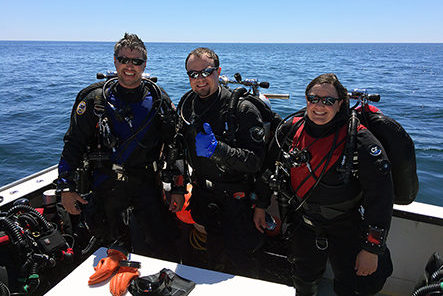
Upon returning to the surface, we celebrated a week
of successful, safe and fun dives. We
had great weather and had an opportunity to learn about an incredible part of
history. We were treated very well
and made to feel welcome by all of the local divers. Special thanks to Capt. Jean-Pierre Bouillon, mate Simon
Pelletier and Dany St-Cyr for all their assistance and sharing their knowledge
and stories with us. The foreboding
Empress forever lurks off Point-au-Pere, you can feel and see it everywhere.
Everyone knows about the Empress but those who venture to explore her
remains are part of a small, elite cult of passionate divers.
This wreck is not for everyone, and the short list of divers who have
visited her is a testament to that truth. The
Empress is a special dive, a difficult and sometimes a scary dive and most of
all, a wreck to be respected. Many
lost their lives tragically and violently-- the eternal unrest of the 1012 souls
entombed within her is ever near.
Despite the often times poor, adverse conditions that
one must endure to dive this wreck, we became enthralled by the allure of the
Empress-- around every corner, under every piece of debris and within the maze
of twisted metal lay a mystery. Each
dive is a glimpse into a forgotten era, a snapshot of something once full of
life, now discernible only by a decaying hulk and its fractured treasures as an
inevitable blanket of dark silt slowly erases it from existence.
What lures us to this rusting relic?
Rapture of the deep? The
mesmerizing draw and timeless beckoning of those from a lost past?
A ship with an unfinished story yet to tell?
You decide.