The Empress of Ireland: An Essay
Written by Heather Knowles, with David Caldwell
Copyright © 2003 Northern Atlantic Dive Expeditions, Inc.
All Rights Reserved
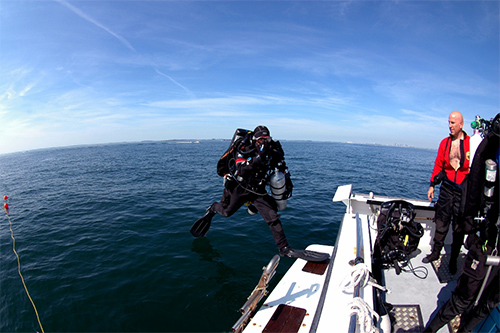
I rolled off
the boat, piercing the quiet calm of the surface as I departed from a clear blue
cloudless sky hanging above our heads. As
my body passed into the watery realm, the river reached out and in a seeming
paradox wrapped it’s arms around me as if to embrace an old friend while the
flowing current sought to drive me away as if I were an intruding, uninvited guest.
Beginning our descent into a seemingly still and empty canyon of cold
green water, we silently slid down the line into the virtual night, through the
murky, dark moods of the river until slowly emerged the ghostly giant sleeping
below- the Empress of Ireland.
Arriving on the wreck, I remember the Empress just the same as when I departed
nearly one year ago- the giant sweeping hull and the rows of portholes amidst a
blanket of vibrant growth, swaying gently in the motion of the water. Emerging
from the darkness, eyes focusing to the night, the huge ship revealed herself.
We had dropped through the dark and cold water to arrive at a distant and
forgotten place… we
had returned to the Empress of Ireland.
Built by the Fairfield Shipbuilding and Engineering Company, located near
Glasgow, England and launched on January 27, 1906, the triple-screw steamer
"Hull No. 443"-- christened Royal Mail Steamer Empress of Ireland, was
just over 548 feet long, 65 feet wide and weighed in at 14,500 tons. The pride
of the Canadian Pacific Railway Company's Atlantic fleet, the Great Ship could
carry in excess of 1500 passengers as she was graced with eight decks that
afforded first, second and even third class passengers some of the best
accommodations for the day. Referred
to as a three-deck shelter deck ship, the Empress, with her grandeur, elegance
and graceful lines, epitomized the sleepy tranquility of the Edwardian age– a
time of unprecedented social and economic prosperity. And indeed, the loss of the Empress of Ireland would mark
it’s crashing for just a few short weeks following the sinking when the world
was thrown into turmoil as the Great War unfolded in June of 1914.
Life would never be the same again.
Certainly
for those on the Empress of Ireland on the fateful night of May 29, 1914, life
or death would be reduced to a cruel roll of the dice.
It was her
ninety-sixth voyage and she was returning home to Liverpool.
It was Captain Henry Kendall’s first voyage as her Master.
It was an unthinkable accident and in the terrifying fourteen minutes
following the devastating collision with the Norwegian collier Storstad, 1012
people perished in the icy waters of the St. Lawrence River off Father Point. As quickly as an ethereal and blinding blanket of fog cloaked
the two ships, it departed, leaving only the mangled Storstad afloat amidst a
sea of human carnage emerging from the dead ship. The Empress of Ireland was
gone in the blink of an eye, a thought so incomprehensible that it was buried
away like a fading memory; yet this tragedy is one that will forever haunt the
waters off Father Point, lingering in the minds of those bound by the intrigue
of her story.
Battling
the 35 degree water, we swam to the forward section of the ship, near the helm
station that once overlooked the magnificent bow, the view to the open sea
through which the Empress once sailed. Now, the dark silty water blinds distant
sight like very the fog that shrouded the Empress on her fateful night. Swimming
along the deck, I glanced at the planks of wood, some as solid as the day the
were installed, others jutting out as if to fall away, and wondered what it
would have been like to walk the decks of the ship.
We dropped deeper towards the starboard rail, where a few skeleton-like
lifeboats clung to the ship. It was
dark and cold down there, the murky water and salinity gradients distorting visibility to a blur.
There is often a difference between things as they appear and things as they
really are. And true it was for the looming shadow of the Titanic disaster in
1912 was
not without significance with respect to misconceptions about safety in
transatlantic travel during this time. The
horrendous loss of life resulting from the sinking of the RMS Titanic could have
been entirely avoided had the ship carried enough lifeboats for all its
passengers. As such, the Empress was outfitted with lifeboats for far more
passengers than she carried and the CPR touted safety as an elegant feature of
Empress steamer travel. The public certainly responded well to this emphasis on
safety with frequent, impressive on-board drills, which helped put to rest fears
of history repeating itself, quieting public outrage from discoveries about the
inherent weaknesses of the Titanic in the subsequent inquiry following her
sinking. Another important event in the development of safety advancements in
transatlantic travel was the sinking of the RMS Republic in 1909. In this case,
great loss of life was avoided, which was a result of her slow sinking as well
as the use of the Marconi telegraph. The sinking of the Republic marked the
first time the Marconi telegraph was used to transmit an SOS and it was wildly
successful. In a tragic irony, the Empress of Ireland carried both far more
lifeboats than passengers and the Marconi telegraph-yet the severe list and
overwhelming rate of flooding, over 60,000 gallons per second, made these items
of little use to the sleepy passengers left struggling for survival in a dark
ship sinking quickly.
Enough
lifeboats for all. A wireless radio
to transmit distress signals. How
could it have gone so wrong?
We descended down the line after the swim along the surface. The visibility was really quite good, about 30-40 feet near the surface, but the dark shroud of the ghostly wreck soon fell. By the time we reached 60 feet, the water had become pitch black with about 1-2 feet of visibility. The water column was a suspension of large and small particles, completely blinding. Deeper as we went, the water suddenly became a senseless dark brown in color until out of no where the wreck appeared. Upon reaching the wreck, the familiar portholes stood out dramatically from the dark like tired eyes longing for visitors. We dropped over the rail and began our swim aft. Our eyes at last focused to the watery night, and the visibility opened up to clear dark 20 feet. I looked up and could see the top of the rail, light filtering through like wet rays of green sunshine. I looked down and could see the sloping deck, disappearing into a gloomy haze. We continued aft until we came across the remnants of what appeared to be the first class dining room. There was a large fireplace protruding up from the wreckage. Nearby there were a large number of tiles, and it seemed we were in the aft section of the first class dining room. I imagined people once eating and drinking in this place, while all above us, the dark wreck reached over like a steel ceiling.
Despite her early success as a mail steamer, troubles began soon enough for the Empress. On one such occasion on October of 1909 off Cape Chat, the ship struck a "submerged derelict", causing what appeared to be minor damage to the hull. She wobbled into Quebec where she offloaded her passengers and made ready to undergo repairs. When divers were finally able to inspect her hull, they discovered she had suffered considerable damage below the waterline from striking the submerged object. Upon her hasty return to Liverpool, additional inspections that revealed more serious damage than initially reported and she was dry-docked for extensive repair. During this time and of note, a discussion of her steering abilities was considered as a potential contributing factor to this incident. Though never formally attributed to the cause of the October 1909 accident, such a theory of the Empress having a wild helm would be significant later during the analysis of her fateful collision with the Storstad in 1914. And indeed, while the CPR never acknowledged a steering problem with either of the Atlantic Empresses, they had already quietly replaced the rudders in both ships in 1907. Perhaps, it was not enough.
We swam forward towards the end of the second-class dining area, passing over a
cargo hatch and the remnants of a large wall coming up. We floated down along the
steeply canted deck towards what once made up the rubber floor
mats in the bar - now just a confused pile appearing as if it were a discarded, half finished
puzzle. Approaching the starboard rail, large timbers of decking and debris from the collapsed upper structure
littered the area, which stretched out into strewn debris. We rose back up towards the
second-class smoking room and bar area, swimming forward towards the second
class dining area. Coming upon a large protruding structure glowing in anemones,
we rose over the
remaining wall, and began swimming through it. We looked up, our bubbles chasing
the rail glistening above, with wooden beams and steel hull plating
spanning up towards the surface wrapped in green gauze light. What a
sight. What a ship.
While the
Empress of Ireland made her own name in transatlantic travel, there was another
who was making his mark and whose name would later link seemingly unrelated but
equally historic events. Captain Henry George Kendall, as master of the steamer
Montrose, achieved fame in 1910 with his actions that lead to the capture and
arrest of Dr. H. H. Crippen, who brutally murdered his wife and attempted to
flee to Quebec aboard the Montrose. Kendall recognized Crippen and his mistress
aboard the ship, befriended and carefully studied them while he relayed messages
of his suspicions to Scotland Yard. The world followed a breathtaking pursuit in
which police chased the Montrose across the Atlantic, attempting to intercept
the ship before Crippen could escape. In fact, Crippen's attempts at flight were
foiled and he was arrested at Father Point on July 31, 1910. As he was lead
away, Crippen placed a curse on Captain Kendall, the man who seemed to genuinely
befriend the suspected killer on the voyage all to coldly betray him, declaring
that Kendall would, "suffer for this treachery". However benign these
remarks appeared at the time, the events of that dreadful night on May 29, 1914
certainly gives one pause to consider that Father Point, where Crippen was aptly
apprehended, was the point of collision with the Storstad on the Empress of
Ireland's fateful voyage-and the first of which Captain Kendall was Master of
the Great Ship.
The days leading up to the Empress's departure from Quebec City were not without
significance either. Many passengers experienced great feelings of discomfort
about the voyage; some of who were convinced the ship was doomed. Various
passengers reported eerie premonitions of impending doom. One noteworthy
passenger was seven-year old Gracie Hanagan, who refused to sleep in a berth
that was next to a porthole, as she believed that this was "where the water
will come in." Sadly, young Gracie was correct and both of her parents
drowned that night. Grace Hanagan, later known as Grace Martyn, was one of four
children in saved out of 138. She remained very involved with the Empress
throughout her years and was reportedly quite fond of speaking to divers who
visited the wreck site. Grace Martyn was the last survivor from the Empress
sinking to die in 1995. There was yet another passenger aboard the Empress with
a seeming sense of worry. The ship's cat Emmy, who had been a faithful stowaway
for several years without missing a voyage, repeatedly attempted to flee from
the ship prior to departure. She ultimately succeeded in escaping and the
Empress departed without her. She watched the ship sail away from Quebec City
sitting atop of the shed at Pier 27, which would later become a macabre
makeshift morgue for the lifeless bodies pulled from the river.
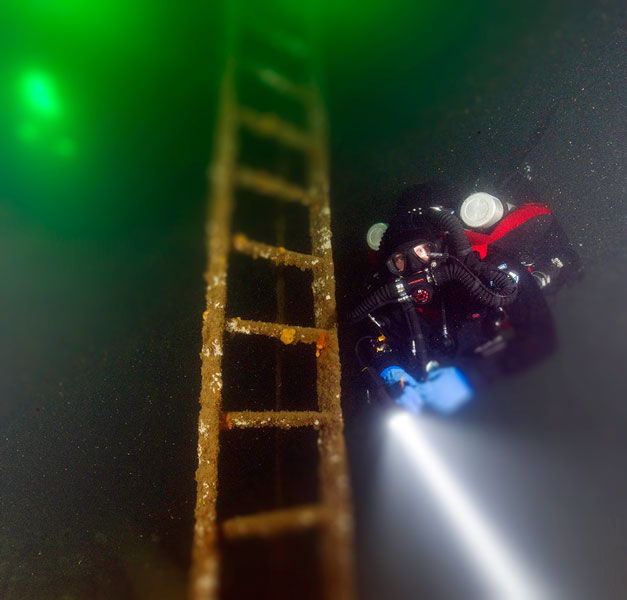
Our lights fighting the overwhelming onslaught of darkness as we descended into the abyss of the Empress, we found ourselves in front of the opening leading to the once Grand Staircase. This was a beautiful feature of the ship, its sweeping banisters and wide steps once fanned out in a graceful elegance that epitomized the golden age of steamer life. All that remains now are the silt covered wooden banister and the bottom step. Collapsed decks and the trials of time have taken their toll. Continuing our descent, we plummeted down to where the skylight entrance was. We dropped in and I held my light steady while Dave fanned away the silt revealing the famous "black and whites"- the ceramic black and white tiles that once made up the galley, bathroom and pantry floors. The silt and debris covering the wreck conceals many of the tiles, but when the eye catches a patch of them, they emerge brightly as reminders of the life this wreck once lived, appearing as they did 89 years ago.
The
collision between the Empress of Ireland and the Storstad occurred at 1:55 am,
at time at which most, if not all passengers were sleeping in their cabins. The
ships sighted each other off Father Point and were on courses such that if
neither vessel altered course or speed, they would have passed each other
uneventfully. Many of us would have
never heard of the Empress and this story would have ended here. However, as if
ghost of Crippen himself reached out in an act of revenge against Kendall, a fog
bank emerged and enveloped both ships. Yet
it was the Storstad that altered course in fog breaking navigational rules of
the road, making a dramatic swing to starboard– one that ultimately drove her
bow right into the starboard side of the Empress.
Why would the Storstad have done such a thing? If the crew of the Storstad
believed the Empress was turning to starboard based on their claim of seeing the
red sidelight, she was surely altering course to allow a wider berth for the
Great Ship. The men from the Storstad never deviated from their assertion that
they had seen the red sidelight and as such, one possible explanation for both
their sighting as well as their alteration in course was that the Empress had
over shot her intended heading when changing course and for just a moment, that
pivotal moment upon which so many lives hinged, before disappearing in the misty
fog, had revealed her red sidelight. After all, the subject of the Empress of
Ireland's steering qualities and her wild helm had been discussed before and
most certainly was a bone of contention at the inquiry following her sinking,
though once again dismissed as a contributing factor. Nevertheless, the inquiry
headed by Lord Mersey, who presided over both the Titanic inquiry in 1912 and
subsequent Lusitania inquiry in 1915 deemed the Storstad was responsible for the
collision. Indeed, if nothing else, the fact that the Storstad altered course in
fog, which violated navigational rules of the road, was enough to pin the
liability upon her. In the end, the Storstad was auctioned and the proceeds were
paid out to the families for loss of life and property claims. She returned to
service after being re-purchased by her owners and eventually met her end when a
German U-boat torpedoed her.
The Empress of Ireland had completely foundered, disappearing beneath the waves
in a mere fourteen minutes. Survival was both Darwinian and arbitrary. Despite
there being more than enough lifeboats for all passengers, the severe list of
the ship made it impossible to deploy them. Many passengers were trapped below
decks, struggling to reach the stairwell that had replaced the ceiling. Third
class passengers suffered the worst casualties, although many in First and
Second class perished as a result of their complacency from the disbelief that
the ship was sinking. Those who made it on deck were subject to falling debris
and deck gear– doctors observed that many passengers died as a result of
physical injury, not drowning. It was nearly impossible to fathom how a
collision that felt as gentle as a bump could sink the ship so quickly. Naval
architects had designed her to be self-righting and buoyant with any two
compartments flooded. But once the Empress began to list, it was not possible
for crew members to manually close each watertight bulkhead door, as there was
no control from the bridge to do so. And certainly, some died at their posts
attempting to do their duty.
Quickly the tragedy of the Empress of Ireland disappeared from the public forum.
The world was quickly embroiled in war following the disaster and quite simply
put; the loss of the Empress had no explanation to comfort those seeking
closure. There was no iceberg, no storm, and no fatal flaw in the ship's design
that would explain away the devastation. The ship also lacked the famous society
“names” as were present on the Titanic, which drove the public need for an
explanation. It was simply a
collision that took the lives of 1012 people despite the availability of the
most modern safety equipment. And that is something most would prefer to forget.
The Empress, however, has a lasting legacy for those who seek to visit the remains of the Great Ship. Unlike the Titanic, this wreck lies on her starboard side at an angle of approximately 60 degrees and in approximately 140' feet of water only a few miles from Father Point. The wreck site is known for harsh, difficult conditions, which is all too fitting given the dreadful demise of the Great Ship. Often times, divers must battle ferocious current and nearly impenetrable darkness that despite the brightest lights, reaches out like the death grip of desperate hands grasping for the surface– but the Empress is very much alive despite the gloom of her crumbling remains. She is a haunted ship if there ever was one and those entombed within her are most certainly not at rest. The darkness, the cold and sweeping currents are the ghosts that guard this wreck, attempting to dispel visitors who seek to explore her, yet casting a mesmerizing spell on those who persist to return at the same time. Almost every diver who has visited the Empress has experienced the bizarre, the inexplicable and the disturbing all for the chance to appreciate the beauty and grandeur of the wreck, to enjoy a journey through the history of a time none of us will ever know.
All
too soon our dive came to an end, the numbing cold beginning to overwhelm our
resolve. Stiffening hands, and creeping cold cascading down our bodies
forcing a premature departure, we reluctantly turned back - always leaving something unseen, undone, or
unfinished. Such is a theme with the Empress. We rose to the rail and
transited the distance to the line leading to surface. Numb hands hastily
unfastened our stage bottles from the wreck and clipped them off, preparing for
our ascent. Struggling against a desire to stay, and a need to go we
grasped the line in our hands and began the measured rise, slowly watching the
dark hull disappear beneath us. We were leaving too soon... again.
When could we come back? Closer to the surface, the Empress a world away,
the pale green water lit a path, a portal to the surface, as if to guide us
back. Drifting back to the boat in the current, eyes readjusting to the
sudden brightness of the daylight, we glanced out to the horizon - at land that
was so
close yet so far away.
Despite the adversity of the dive, there is an undeniable and addictive allure
associated with diving the Empress – around every corner, under every piece of
debris and within the maze of twisted metal lies a mystery. Each dive is a
glimpse into a forgotten era, a snapshot of something once full of life, now
discernible only by a decaying hulk and its fractured treasures as an inevitable
blanket of dark silt slowly erases it from existence. What lures us to this
rusting relic? Rapture of the deep? The mesmerizing draw from the timeless
beckoning of those lingering between the next world and a lost past? A ship with
an unfinished story to tell waiting for a listener? You decide.
Bibliography:
Croall, James. "Fourteen Minutes, The Last Voyage of the Empress of Ireland."
Stein and Day Publishers / Scarborough House, NY, 1978.
Zeni, David. "Forgotten Empress."
Goose Lane Editions, NB, Canada, 1998.
Contact us at wreckdivers@northernatlanticdive.com