SHIPWRECKS

OF MASSACHUSETTS BAY

© Copyright 2003-2007, Northern Atlantic Dive Expeditions, Inc.

All Rights Reserved


PINTHIS


Photo: Fishable Wrecks and Rockpiles by Tim Coleman and Charley Soares


Type: Coastal tanker
LOA: 206'x35'x16'
Construction: Steel
Date of Loss: June 10, 1930   
Reason: Collision with the steamer Fairfax 
Depth of Water: 105 fsw 


History:

 
Built in 1919, the steel coastal tanker Pinthis was a typical steam vessel of the day.  Following a departure from Norfolk, VA and carrying a cargo of 12,000 barrels of oil, the Pinthis collided in fog with the steamer Fairfax sustaining a mortal blow to her port side.  An explosion resulted and in less than 20 minutes, the tanker capsized and sank.  All 19 of her crew were lost in the sinking.  The sea burned for several days following the sinking from the escaping oil.  The Fairfax was set afire and many of her crew were injured or burned to death from the resulting explosion.  Despite the damage, however, the Fairfax was spared.  In the end, 47 people lost their lives from this tragedy.
 
Boston Globe article covering the 1930 sinking of the Pinthis
 
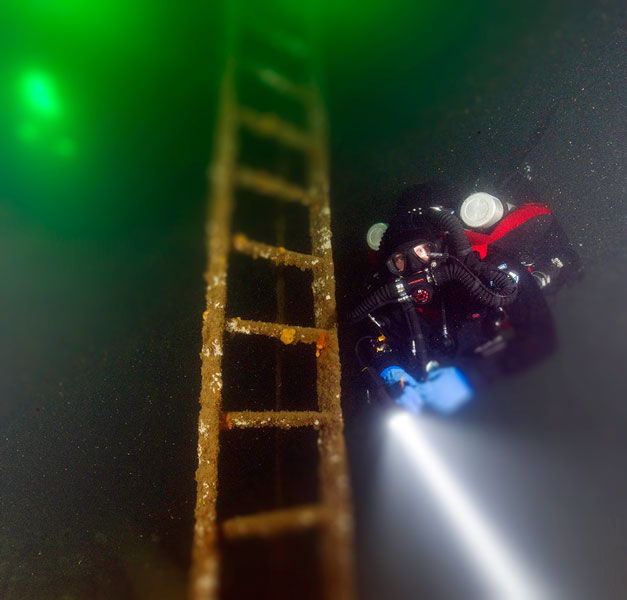
Today, the Pinthis lies in approximately 105 fsw, turtled.  She is largely intact, although some of her hull plates have collapsed.  Penetration into a cavern-like interior is possible, though some areas can become constricted among the mangled wreckage.  The wreck has a "machine-gunned" appearance, a result of the burned out rivets once holding her plates together through which light filters.  Visibility averages 25-30' and currents are light to moderate in this area.  The wreck lies on a rock and sand bottom, which helps to keep the visibility good.  There is some fishing line to be weary of, as this wreck is also popular among cod fisherman.  However, generally speaking this wreck serves divers well.
 
Photos:
 
The Fairfax following the Pinthis sinking.

Photo:  Shipwrecks Around Boston by William P Quinn


Hull plates in the forward section.
 
 
Bow chain (left) and at right looking back at the hull from the end of the bow.
 
 
The port side of the wreck has a few openings but is mostly an intact, smooth hull.
 
 
An opening to the interior of the wreck (left) and (right) the top of the hull.
 
 
An opening into the interior along the starboard side of the wreck (left) and (right) collapsed hull plates in the bow area.


Back to Mass Bay Shipwrecks    Back to Main Page     Shipwreck Junction